Best AI Interview Software for Manufacturing Hiring
Production applicants apply on a phone and take the first plant that calls back. Eight AI interview and video tools compared on how they screen operators and skilled trades, and what each costs, read from the vendor on the date shown.
By the InterviewAgent.ai team
October 2026 · 8 min read
First-round interview
Candidate consented · AI-conducted00:00 · AI Interviewer
Run the sample interview to watch the AI ask, follow up and score against your rubric.
Scored report
RubricThe report assembles after the interview: overall score, rubric, highlights and a recommendation. You make the final call.
Highlights
Recommendation only · a recruiter makes the final decision
Ranked shortlist
Live, interactive · consent-first · no signup needed
Structured & consistent · bias-audited (EEOC / NYC Local Law 144) · you make the final call
The best AI interview software for manufacturing hiring is the one that screens production applicants within hours, on the phone they already carry, against the shift, safety and skills questions your supervisors actually ask. If you want an AI to conduct and score that first round at a published price, InterviewAgent.ai (from $149 a month for 100 interviews), Classet ($249 a month billed annually for 50 phone interviews) and Ribbon AI ($499 a month billed annually) all print one. If you only need candidates to record answers for a supervisor to watch, Hireflix is the cheapest at $75 a month billed yearly. Prices were read on each vendor's site on the date shown in the table.
Plant hiring has a problem office hiring does not. Deloitte and The Manufacturing Institute estimate that US manufacturers could need as many as 3.8 million new employees between 2024 and 2033, and that about 1.9 million of those jobs could go unfilled if the skills and applicant gaps are not closed. The applicants who do show up for machine operator, assembler, forklift and maintenance roles tend to apply on a phone, often after a shift, and take whichever plant calls back first.
That makes the first-round screen the bottleneck. An HR coordinator at a 300-person plant cannot phone-screen 80 applicants for a second-shift opening before Friday, and every day of delay loses the best of them. This guide is for a plant HR manager, an operations director or a multi-site talent lead weighing AI interview software for hourly and skilled production roles. We build one of the tools below, so treat that as a disclosed interest.
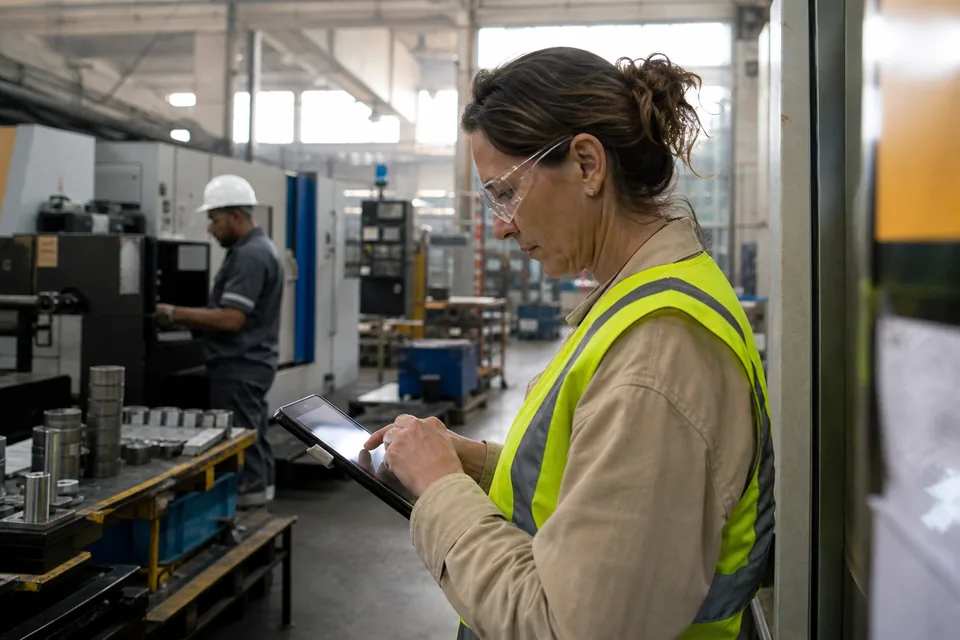
AI interview software for manufacturing compared on price and format
| Tool | How the candidate is screened | Published price | Fit for plant hiring |
|---|---|---|---|
| InterviewAgent.ai | An AI agent interviews by voice, video or in writing from a link, asks follow-ups and scores every answer against your rubric | $149, $399, $999 and $1,998 a month for 100, 300, 750 and 1,500 interviews; half that billed yearly | Scored shortlist by morning for shift and skilled roles, with transcripts a supervisor can check |
| Classet | An AI phone interviewer calls the candidate, 5 to 10 minutes, in 25+ languages | Starter $249 and Scale $999 a month billed annually, or $349 and $1,399 monthly; 50 or 250 completed interviews, then $5 or $4 each. Read October 13, 2026 | Built for hourly and industrial roles; strong where bilingual phone screening matters |
| Ribbon AI | An AI recruiter runs voice and video interviews | Growth $499, Business $999 and Scale $1,999 a month billed annually. Read October 6, 2026 | Volume plans with seat and active role caps |
| Interviewer.AI | AI scores one-way recordings; conversational interviews from Professional | Essential $199 and Professional $399 a month. Read October 7, 2026 | Better for salaried roles; ATS integrations on Enterprise only |
| Fabric | An AI agent interviews and checks for AI-assisted answers | Free tier with credits, then $199, $399 and $499 a month. Read September 26, 2026 | Leans toward technical and remote roles |
| Paradox | A chat assistant asks knockout questions and books interviews | Not published. paradox.ai/pricing redirects to the homepage. Read October 12, 2026 | Long-standing in large hourly employers; scheduling more than scoring |
| Spark Hire | Candidates record one-way video answers; live video too | $249 a month billed annually, or $299 month to month. Read October 8, 2026 | A person still watches every answer |
| Hireflix | Candidates record one-way video answers | $75 or $150 a month billed yearly, $150 or $300 month to month. Read October 13, 2026 | Cheapest recording tool; no AI scoring |
Five of the eight print a price for an AI that conducts the screen, two sell recording tools that leave the judging to your team, and one sells by quote. The full plan breakdown for the cheapest recording option is on our Hireflix pricing page.
What should a manufacturer look for in AI interview software?
Look for four things: the interview reaches applicants on a phone without an app or a laptop, it asks your plant's own questions about shifts, safety and equipment, it scores every answer the same way and shows why, and a person makes every decision. Anything that fails one of those creates rework for the HR coordinator it was supposed to free up.
The first point matters more on a plant floor than anywhere else. Many production applicants never open a laptop in the hiring process. A link that opens in a phone browser and lets the candidate answer by voice keeps completion rates up. A tool that needs a webcam on a desktop quietly filters out people who would have been good at the job.
- Shift and schedule fit: rotating shifts, weekends, mandatory overtime, start date
- Safety and compliance: PPE, lockout/tagout awareness, forklift or crane certification, the ability to pass a pre-employment drug screen where your policy requires one
- Skills claims: reading a caliper or a blueprint, CNC setup versus operation, PLC troubleshooting for maintenance techs
- Reliability signals: transportation, how they handled a missed shift at a previous job
Which AI interview software is best for high-volume production hiring?
For a new line, a seasonal ramp or a second shift where you need 30 to 100 operators fast, pick a tool that interviews every applicant the night they apply and hands the coordinator a ranked list in the morning. Volume pricing and speed matter more than polish here, because the plant that calls back first usually wins the hire.
InterviewAgent.ai interviews each applicant from a link, asks follow-up questions when an answer about shifts or certifications is vague, and scores every answer against anchors your supervisors wrote. On our Growth plan, 300 interviews a month cost $399, about $1.33 each, or half that billed yearly. Classet does the same job by phone call, which suits candidates who would rather talk than tap a link, and its 25+ languages including Spanish are a real advantage at plants with a bilingual workforce. Ribbon AI publishes volume plans from $499 a month billed annually. Our high-volume hiring software page and our wider guide to AI interview software for high-volume hiring go deeper on the volume math.
Hiring for a new shift usually starts with the production plan, not with HR. If the plant is adding a shift because the order book changed, the planner knows the start date and headcount weeks before the job ad goes up, and production scheduling software that shows the capacity gap early gives HR a head start on screening.
What is the best AI interview software for skilled trades and maintenance roles?
Skilled roles such as maintenance technician, CNC machinist, welder and electrician need a screen that tests claims, not just availability. The right tool asks a candidate who says they troubleshoot PLCs to walk through a recent fault, follows up when the answer stays general, and records exactly what they said so the maintenance manager can judge it.
That is where a scored conversation beats both a knockout chat and a recording. A chat assistant can confirm a certification but cannot probe depth. A one-way video captures an answer but cannot ask the next question. Our agent asks the follow-up and attaches the transcript quote behind each score, so a maintenance manager can read three strong candidates in ten minutes instead of watching twenty recordings. How scoring works on our side is set out on candidate interview scoring.
How much does AI interview software cost for a manufacturing plant?
For a single plant hiring 50 to 300 people a year, expect roughly $150 to $500 a month for a tool that conducts and scores the first round, and $75 to $300 a month for a recording tool your team reviews. Multi-site manufacturers with thousands of hourly hires usually end up on a quoted enterprise contract.
Compare cost per screened candidate, not the sticker. At 100 applicants a month, our Starter plan is $1.49 an interview at the monthly price and about 74 cents billed yearly. Classet Starter is $249 a month billed annually for 50 completed interviews, about $4.98 each, then $5 per extra interview. A recording tool looks cheaper per candidate until you count review time: five two-minute answers per candidate is about 17 hours of footage for 100 applicants, and at a plant that time usually comes out of a supervisor's shift.
Is it legal to use AI interviews for hourly manufacturing jobs?
Yes, with conditions. US employment law applies to an AI screen exactly as it does to a phone screen: questions must be job-related, the same for every candidate in the role, and the process must not screen out a protected group at a higher rate without a business reason. Some jurisdictions add notice or audit rules, such as New York City Local Law 144 for automated employment decision tools and Illinois for AI analysis of video interviews.
Two practical rules keep plant HR safe. Never let the tool reject anyone on its own; it should rank and a person should decide. And keep questions on the work itself, shifts, safety, equipment and experience, never on age, health, family plans or citizenship beyond lawful work authorization. Our AI hiring compliance page lists what applies where.
How to choose between the tools
Run a two-week pilot on one real opening, ideally a role you hire for constantly, such as a second-shift machine operator. Measure three things: the share of applicants who complete the interview, the hours your coordinator and supervisors spend before a shortlist exists, and whether the supervisor agrees with the top five. A tool that wins on all three at your volume is the right one, whatever its price per seat.
If you want an AI that runs the first round for you and hands your supervisors a scored shortlist, see our plans. Every plan includes voice, video and written interviews, your own rubric, and a recruiter decision on every candidate.
See InterviewAgent.ai screen candidates
The agent interviews every applicant with role-tailored questions, scores against your rubric, and ranks a shortlist for your recruiters. The agent advances candidates, your team decides.